
The UK Beef Welfare Strategy 2026–2031  sets out a clear and ambitious vision for a thriving and sustainable beef sector in which high standards of health, welfare and productivity are achieved for every animal across all farming systems. Whether it is the suckler sector and its exceptionally high welfare, or beef from the dairy herd and its low carbon footprint, the UK have an industry to be proud of.

Central to this vision is the recognition that excellent welfare is inseparable from good stockmanship, robust herd health planning and environmentally and financially sustainable farm businesses. By placing the stockperson at the heart of delivery, the strategy acknowledges that attitudes on farm are the primary drivers of positive welfare outcomes.

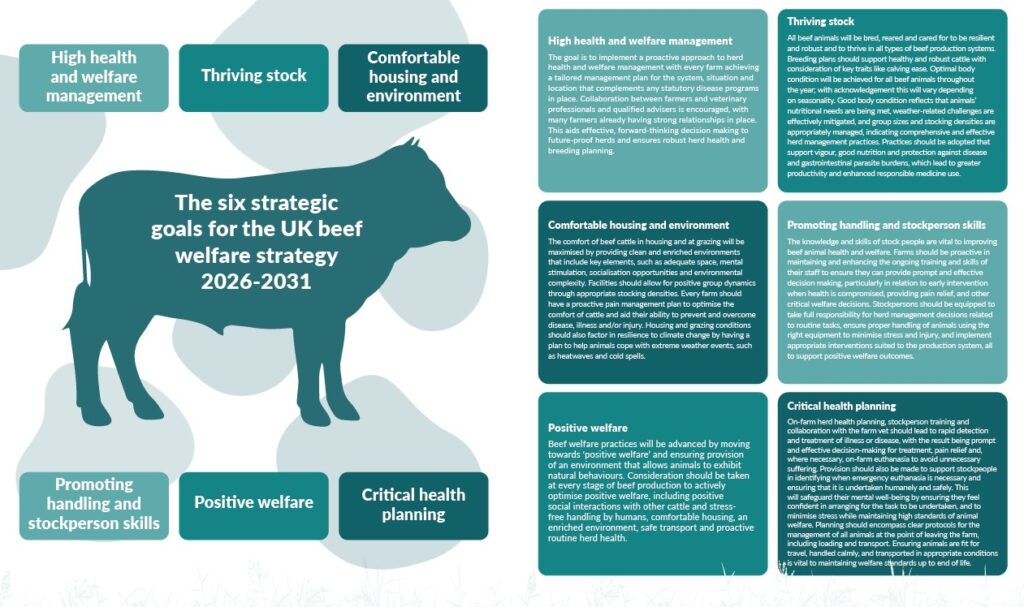
The strategy is built around six key themes: high health and welfare management, thriving stock, comfortable housing and environments, enhanced handling and stockperson skills, the advancement of positive welfare, and critical health planning. Together, these priorities promote a proactive and preventative approach, moving beyond the treatment of disease towards systems that enable cattle to be resilient, healthy and able to express natural behaviours.

Improving herd health is a key foundation because it delivers benefits that extend beyond welfare to include reduced environmental impact, more responsible use of medicines and improved farm performance. At the same time, the strategy emphasises the importance of forward planning, collaboration with vets and the integration of welfare considerations at every stage of the production cycle, including transport and end of life.

There is also a strong focus on reputation and public trust. Delivering clear improvements in welfare will be critical to maintaining consumer confidence and securing future market opportunities, both domestically and internationally.
Strategy delivery plan

The five-year strategy will be executed taking the following five step approach:

  1. Engagement – Commitment by all stakeholders to engage with this strategy and deliver against the six goals
  2. Dialogue – Routine delivery of meetings with stakeholder representation to create a dialogue, and move towards developing and coordinating agreed priority SMART* actions for each of the six goals
  3. Collaboration – Whole supply-chain collaboration to ensure the strategy is promoted, proactively driven forward and reported against for the benefit of the whole industry
  4. Evidence – a) Development of capacity for the collation and delivery of an evidence base b) Industry-wide tracking of KPIs and centrally collated data to build an evidence base and clearly report annually against the identified actions within each of the six goals
  5. Progress – Demonstration of results and progress against the strategy, ensuring the priority actions concerning beef cattle welfare are disseminated right through the industry via knowledge transfer

This 5-year UK Beef Welfare Strategy should be viewed in tandem with the GB Calf Welfare Strategy 2025-2030

*SMART – Specific, Measurable, Achievable, Relevant and Time-bound

Supporting Organisations

Agriculture and Horticulture Development Board (AHDB)
AIMS
Animal Health NI
Boehringer Ingelheim
British Cattle Breeders Club (BCBC)
British Cattle Veterinary Association (BVCA)
Buitelaar
Calf To Cow Consultancy
Cargill
Defra 
Genus ABS
Hartpury University and Hartpury College 
Hereford Cattle Society
Hurst Animal Health
Kingshay
Livestock Auctioneers Association (LAA)
MSD Animal Health 
National Beef Association (NBA)
NFU Cymru
NFU Scotland 
OSI and Pickstock Telford 
Pathway Farming
Quality Meat Scotland (QMS)
Red Tractor 
RSPCA
Ruminant Health and Welfare (RH&W)
Sedgemoor Auction Centre
Synergy Farm Health
VetPartners 
Zoetis